

A cookie banner can look correct while tracking still runs before a visitor makes a choice. Check not just the buttons but outgoing requests, stored data and behavior after a preference change. An empty cookie list alone does not prove the website sent nothing anywhere.
The following procedure is technical diagnostics for website owners and marketing analysts. It helps prepare a specific brief for the website administrator. It is not a legal opinion or confirmation that a particular implementation complies with regulations. The original test below ran on an isolated local page, not a production website or a real CMP.
Inventory services and actual data
Start with an inventory: analytics, advertising tags, videos, maps, chat, authentication and extensions loaded through a tag manager. For each service, record its purpose, operator, destination domains, stored data and the person responsible for the integration. Category names in a banner are not a reliable inventory of what a page actually runs.
Further reading




Distinguish storing or reading data on a device from subsequent processing of personal data. The Czech Data Protection Authority’s questions and answers state that non-technical cookies require prior consent. For technical cookies, they explain the exemption while also noting the duty to provide information. Labeling a service ‘functional’ in an administration interface is not enough to prove it is necessary.
The statutory starting point is Section 89(3) of Czech Act No. 127/2005 Coll.: prior demonstrable consent to scope and purpose, with defined exemptions for technical storage or access. When checked on November 18, 2026, e-Sbírka displayed the current wording effective from November 1, 2026, but also warned of a possible amendment not yet incorporated. A specific legal decision requires checking that context too. A technical test cannot resolve it.
Test a new visit, rejection and consent
Prepare a clean browser profile without extensions that might block tracking themselves. Before loading the page, open developer tools, enable network recording and note the cache settings. A private window may not accurately represent an ordinary visitor: it can have different third-party cookie rules. Always include the conditions with the result.
- New visit without a choice: load the page without clicking the banner. Record requests, cookies and local storage. Also check delayed tags after scrolling.
- Rejection: in a separate clean run, reject optional purposes. Repeat navigation and relevant actions.
- Consent: allow specific purposes and check not only activation but transmitted parameters. Use synthetic values, not an email address or real customer details.
- Return visit: reload the page and check whether the saved choice matches what starts again. The banner disappearing proves no such thing by itself.
The original demonstration page uses two local destinations: /collect for a synthetic analytics event and /embed for a simulated embed. The server listened only on 127.0.0.1. On a new visit and after rejection, a real browser made no request to either destination. After consent, it loaded the embed and sent the analytics event. Browser records were compared with the server log.
| Step | New /collect | New /embed | Analytics cookie |
|---|---|---|---|
| New visit | 0 | 0 | absent |
| Reject all | 0 | 0 | absent |
| Allow both purposes | 1 | 1 | synthetic |
| Keep analytics only | 1 | 0 | synthetic |
| Withdraw all | 0 | 0 | removed |
| Event after withdrawal | 0 | 0 | absent |
The table counts new requests in each step, not the entire Network panel history. An old request does not disappear from the record after consent is withdrawn. What matters is whether another appears. The saved preference remained in local storage as rejection; deleting all storage is therefore not a universal success criterion.
Check embeds and preference changes
Test videos and maps separately. They may load only after a preview is clicked or their location on the page approaches the viewport. Check that the actual iframe source is blocked before the required choice, not just covered by a visual overlay. If a third-party iframe loads underneath an information box, covering it has not stopped network transmission.
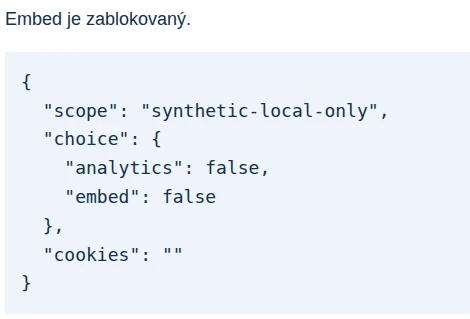
After granting consent, change individual purposes. In our test, ‘Analytics only’ removed the iframe while analytics continued. Withdrawing both purposes removed the synthetic analytics cookie, and subsequently pressing the event button created no new analytics request. It did not undo previously accepted requests, however.
The Complianz documentation on withdrawing consent explicitly distinguishes withdrawal, blocking and cookie removal. It also describes limitations on removing cookies on third-party domains. This is the vendor’s description, not our hands-on test of its plugin. For your own installation, verify its version, integrations and actual behavior after updates.
Distinguish a cookie from sending a request
Google documentation distinguishes basic and advanced Consent Mode implementations. Basic mode blocks Google tags until the user grants consent. Advanced mode loads them with a default consent state and may send cookieless measurement when storage is denied. Do not automatically interpret denied as ‘nothing is sent.’
This does not mean every pre-consent request is in itself a proven legal violation. First identify its recipient, content, purpose, technology and applicable legal basis. Equally, the absence of an analytics cookie does not establish that personal data is not being processed. Whether a particular flow is permissible requires legal assessment, not reliance on a vendor’s feature name.
For a network finding, save the timing relative to the consent choice, destination domain, initiator and relevant parameters. A raw HAR export can contain identifiers, cookies, headers or form data. Review and minimize it before sharing. A sanitized excerpt is normally enough for a public article or task, not a complete operational log.
Assess the impact of incomplete measurement
Fixing blocking may reduce recorded analytics visits. That need not mean actual demand fell. Record the change date and distinguish it from marketing interventions in reporting. Visitors who withhold consent may not be a random sample of all traffic; simply scaling results by their estimated share may therefore fail to reconstruct reality.
Label modeled analytics data separately from observed data. Modeling does not automatically meet every condition for every account either. Connect available measurements with business records to support decisions, but do not create another unauthorized transfer of personal data in the process. The article on measuring conversions from AI traffic develops this further, with the same boundary between observation and unknown impact.
Separate technical findings from legal conclusions
A good technical finding might read: ‘In a clean profile, this tag sent a request before a choice and continued after rejection; I have attached a timeline and sanitized parameters.’ A bad conclusion is ‘everything complies with GDPR’ because the banner disappeared after a click. Assign the finding an owner, a proposed fix and a repeatable regression scenario.
The EDPB taskforce report of January 17, 2023 addresses pre-ticked options, misleading design and easy withdrawal, among other issues. It warns that it is not a standalone ‘green light’ for a particular website. The Czech Data Protection Authority also explains rejection on the same layer as consent and easy withdrawal. Check keyboard and mobile operation too; website usability and technical functionality complement one another.
Start with one important landing page and one complete walkthrough. After a fix, repeat the new visit, rejection, consent, embed and withdrawal. Only a matching result on the actual website supports closing the specific technical defect. This does not automatically verify the legal scope, visitor information or contractual arrangements.
Not sure whether a report reflects performance or a measurement change?
I can help define test scenarios and the impact of measurement changes on marketing decisions. Tell me where your data diverges after a consent change. We will separate the technical fix from any legal assessment according to the expertise required.