


AI-assisted research is usable only when you can trace every important claim to a specific place in the original source and verify its meaning. A PDF link or video timestamp alone is not enough. You need to know whether the tool obtained the complete text, broke a table or actually processed the visuals when the conclusion depends on them.
This workflow is for marketers, analysts and authors of specialist content. It uses an open-access study of language models and two precisely selected frames from an open animated film. It is not a medical demonstration, a benchmark of a research chatbot or a claim that an entire video was automatically understood. The focus is on what can be verified during conversion and where a gap must remain explicit.
Distinguish text, scans, tables and images
A PDF is not a single homogeneous input. It may contain selectable text, image-only pages, tables with different cell relationships and charts. Plain text extraction can obtain words without preserving column order, the relationship between values and headers or information expressed only by a curve. OCR recognizes characters in an image; even successfully recognized sentences do not automatically produce correct table structure.
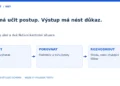

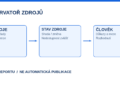

First save the original file and its version. Count the pages, inspect their types and check whether text was actually obtained. Empty output from a scanned page means a missing text layer, not proof that the page says nothing. Render the required page as an image and process it through an appropriate route. For a table, check specific cells, including units, decimal marks, notes and header spans.
For this demonstration, the published article Lost in the Middle: How Language Models Use Long Contexts by Nelson F. Liu and colleagues was downloaded on November 18, 2026. The 2024 TACL publication has 17 PDF pages, numbered 157–173 in the journal. This demonstration did not merely locate a preprint. The PDF was actually opened, extracted page by page and selected pages were rendered for visual inspection.
Physical page 5, printed page 161, contains both Table 1 and Figure 5. The text layer for the Claude-1.3 (100K) row contains an Oracle value of 76.4%. In our run, an automatic table extractor separated the decimal point: it returned “764%” and the point on the next line. Separate OCR of the same page, deliberately converted to an image, read “16.4%” in that cell. Visual inspection of the original confirmed 76.4%. All original outputs were retained; faulty strings were not silently corrected in the raw record.
On a narrow display, scroll the table horizontally; after focusing the region with Tab, use the arrow keys.
| Model | Closed-book | Oracle |
|---|---|---|
| GPT-3.5-Turbo | 56.1% | 88.3% |
| Claude-1.3 (100K) | 48.2% | 76.4% |
This is not a contest to identify the best extractor in general. It is a specific observed error on one page under a particular configuration. Even the text layer alone does not verify table context; here, the correct value is confirmed only by its relationship to the row, header and image. In a financial table, a similar substitution could change a decision while leaving the summary linguistically smooth.
How the file is supplied to the application matters, too. OpenAI’s current file-input documentation distinguishes processing by file type and interface; for PDFs supplied to vision-capable models, it describes both text and page images. That does not prove that any chatbot uses the same processing when given a URL. Our test made no paid model API call; local tools processed the PDF and selected pixels were inspected separately.
For video, separate the transcript from visual evidence
A transcript captures speech as recognized by a person or tool. It does not guarantee correct names, numbers or complete coverage. Above all, it does not prove what appeared in the frame: a number on a slide, a switch state, gesture, displayed table or ongoing action. A video description is another separate source, not a transcript or a record of observed pixels.
For the visual portion, we chose Big Buck Bunny, the original 640 × 360 release from the Blender Foundation archive; the actual video file has a 640 × 359 image and a duration of approximately 596.46 seconds. Higher resolution, a newer edit or a different introduction can shift timestamps. The working register therefore retains the exact file, its fingerprint and frame time. We do not refer only to the work’s title.
Frames at 01:00 and 02:00 were actually extracted and inspected. The 01:00 frame shows a large white rabbit with its head turned upward, sky and tree branches. No text is visible. This supports that narrow description of the frame. It does not confirm what the character said, why it acted that way or what happened in the previous minute. The second frame shows three stylized animal characters in grass; uncertain identification of their individual species is not needed for this explanation.
The file contains an audio track, but it was neither transcribed nor assessed by listening for this demonstration. We therefore do not call the film silent on the basis of two images or invent a supposed transcript. A conclusion about the entire scene would require viewing the relevant interval, not just an isolated frame. Apply the same rule to training material: “the slide contains a table” requires an image; “the speaker recommended a change” requires verified speech and context.
Rights were checked on the official project page: project content is provided under CC BY 3.0, with specified exceptions for logos and other elements. The required attribution for portions of the film is “(c) copyright 2008, Blender Foundation / www.bigbuckbunny.org”. This article reproduces neither film frames nor logos; it only links to the film and describes the inspected excerpt. Open access and permission to reuse are separate questions; for another video, you need to check both.
Assign a page or time to every claim
Create a claim register, often called a claim ledger. Each row should contain one verifiable statement. Split a sentence such as “the study demonstrated deterioration in all current models, so you must move the text”: the experimental finding, scope of tested models and recommendation are three different things. A single citation to the whole study does not automatically support all three.
For PDFs, record both physical and printed pages, table or figure number and section. For video, record the exact version and interval; label an isolated frame as a frame. Add the access method: text extraction, OCR, visual inspection, verified transcript or listening. “Source read” is too coarse a record if the decisive value existed only in a chart.
On a narrow display, scroll the table horizontally; after focusing the region with Tab, use the arrow keys.
| ID | Claim | Locator | Status |
|---|---|---|---|
| S1 | Selected multi-document questions: 2,655 queries | PDF p. 3 / printed p. 159, §2.1 | verified within the study’s scope; not a current benchmark |
| S2 | Claude-1.3 (100K), Oracle 76.4% | PDF p. 5 / printed p. 161, Table 1, row 6 | verified; raw faulty outputs retained |
| V1 | White rabbit with head raised, sky and branches | 00:01:00.000, exact retained version | only the visible frame verified, not cause or speech |
| V2 | What was said in the film | no verified transcript or listening | UNVERIFIED; do not claim speech content |
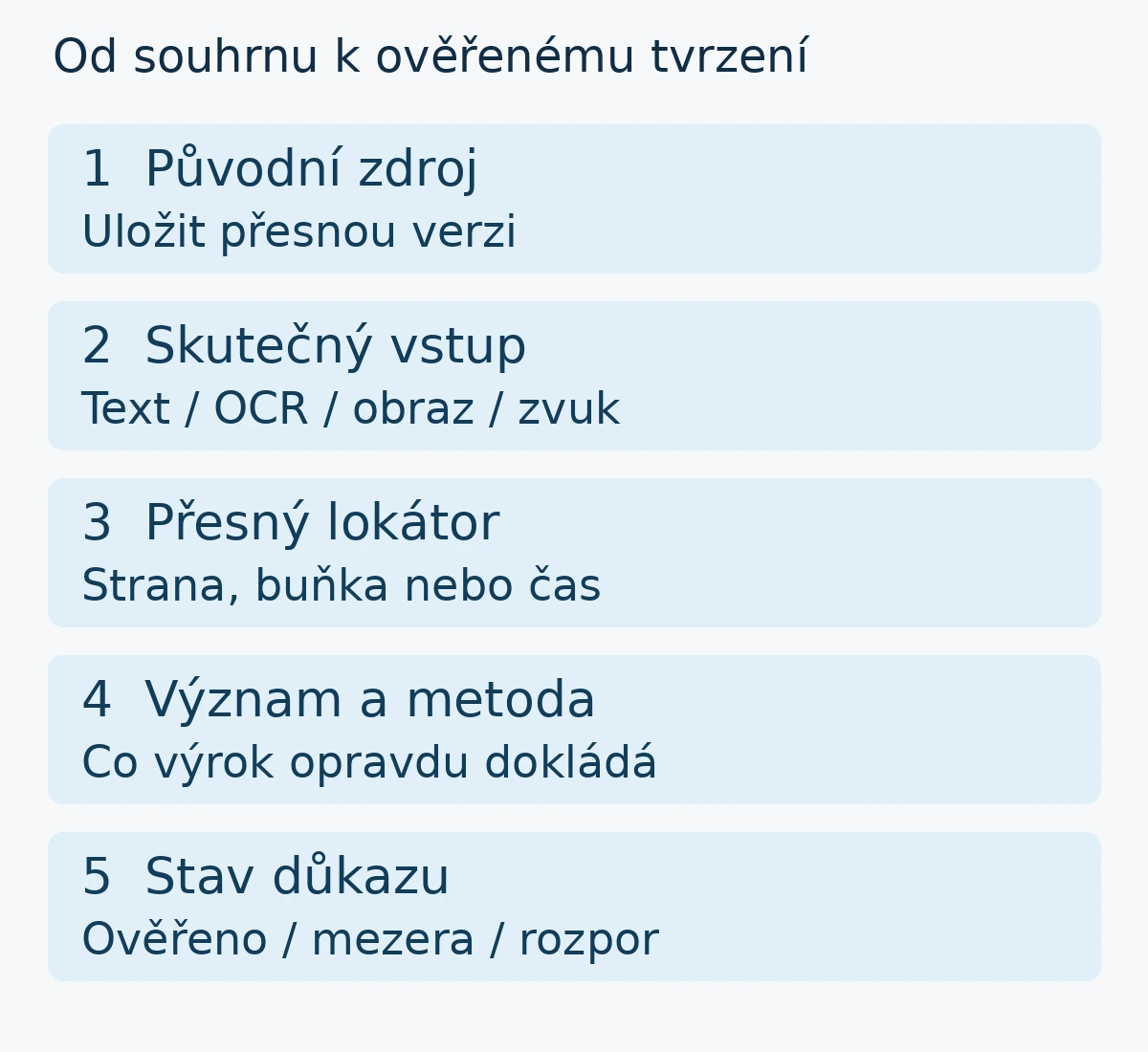
You can copy the blank record into a spreadsheet. Leave fields without evidence marked as missing; do not retrospectively invent plausible pages and timestamps.
- Claim identity
- [ID; exact wording; fact, author’s claim, interpretation or recommendation; intended use].
- Source and version
- [author; title; publisher; URL; publication date; version; access date; saved original and fingerprint].
- Locator and input
- [PDF page / printed page / section / table / cell, or video start–end; text, OCR, image, transcript or listening; scope actually checked].
- Verification
- [supporting passage or image description; methodology; limitations; extraction discrepancy; what the claim does not establish].
- Decision
- [verified within stated scope / partial / contradiction / unverified; reviewer; necessary next step and owner].
A CSV or working-document export should preserve links, Czech characters, qualifiers and open gaps. You can maintain this evidence outside a particular chatbot; for internal work, also respect document-storage rules. Our supporting material included an actual CSV export and a re-import check, not just a screenshot of the table.
Compare the summary with the methodology and limitations
For Lost in the Middle, what the researchers varied matters. In the multi-document question-answering experiment, they used 2,655 selected NaturalQuestions-Open queries whose longer reference answer was a paragraph. They placed one answer-containing document and additional distractor documents in the context, varying their number and the relevant document’s position. The method is described on printed pages 159–160 and the tested models on page 161. Another part of the paper examines synthetic key-value retrieval, not the same questions.
Table 1 on page 161 compares closed-book and oracle settings. In the former, the model receives no documents; in the latter, it receives a single document containing the answer. This is not a table of performance by information position. The adjacent Figure 5 examines that. Visual inspection confirmed its different curves; we did not estimate precise decimal point values from them. A higher Oracle value does not prove that today’s chatbot reads everything you upload.
The summary “long context does not work” would oversimplify even the authors’ own conclusions. In section 3.2, some models perform almost perfectly on the synthetic task. Section 4.1 distinguishes architectures and lengths seen during training. Appendix A flags a temporal mismatch between part of Wikipedia and reference answers and reports an additional ambiguity test. These sections constrain interpretation and should not disappear just because the abstract offers a catchy headline finding.
The 2024 publication uses models from that period, including GPT-3.5-Turbo version 0613 and Claude-1.3. Its result is a reason to test context use in your system, not a ready-made verdict on all models in November 2026. We did not measure the exact ranking of today’s services. Nor does the paper establish a universal paragraph length for SEO or a duty to place every important sentence at the top of a website. The distinction between evidence and a marketing recipe is discussed in myths about GEO and AEO.
Record missing material and evidence status
The final research should be able to say not only “I found this” but also “I did not process this part.” List inaccessible appendices, pages without readable text, unverified numbers, segments without transcripts and charts you did not inspect. Missing material is not a negative study result or proof that something was not said in a video.
In our demonstration, we have the original PDF, extraction of all 17 pages, reading of the main text and relevant appendices, a specific table-extraction and OCR error, and visual inspection of the table and Figure 5. We do not have a reproduction of the original model experiments or a new benchmark of current models. For the film, we have two precisely located visual checks and verified license terms, not a transcript, listening assessment or viewing of the entire film. Those boundaries belong in the evidence just as much as the correct table value.
You can ask AI to propose a register and find candidate passages. Instruct it to separate exact quotations, paraphrases and its own proposals, and to flag missing inputs. That is a useful brief, not a correctness guarantee. Verification returns to the original, and a responsible person approves the conclusion. RAG can retrieve supporting material, but retrieval alone does not confirm its interpretation.
When handing research to an author, include approved statements, their locators and prohibited interpretations in the content brief. For the writing stage, see the AI content workflow. Research ends with usable evidence and explicit boundaries, not necessarily a confident answer to everything.
Need research whose conclusions can be checked?
I can help set up the brief, source handling and evidence review for content or an AI project. Tell me which decision your research needs to support today. We will define the scope of specialist review for the subject; do not send nonpublic documents through the form. We will not present a summary without verified evidence as a finished analysis.




