

Cloud, a self-hosted model and a hybrid can all be sensible choices. What matters is where data may go, the answer quality you need and how much work the system can handle at peak load. Neither parameter count nor the price of a graphics card answers those questions on its own.
Start with operating requirements, not a shopping list. One person occasionally summarizing a public document needs something different from internal support handling long source materials and several simultaneous queries. An application can run on your computer while the language model itself processes data at an external provider. “We host it on our own server” does not describe the entire path.
This article is a research-based decision aid, not an original inference benchmark. I checked documentation and pricing on November 18, 2026; performance figures below come from explicitly identified external measurements. Memory and cost examples are calculated hypothetical scenarios, not results from our server or a vendor quote.
Further reading



Define what may leave your infrastructure
First establish the boundary: which inputs may be processed by a contractually approved provider and which must remain inside. Do not assess only the final query. Scan-to-text conversion, embedding creation, retrieved passages, diagnostic logs or backups may also leave the infrastructure. A locally running model does not eliminate an external step before it.
For public product information, a cloud pilot may be a practical start. For confidential material, the data owner must first confirm the permitted processor, contractual terms and transfers with IT and, where appropriate, a lawyer. Sensitivity is not a universal ban on cloud services; “the vendor has a European region” is not a completed assessment either.
The distinction is visible in OpenAI’s API data rules. The provider says it does not use data for training without explicit opt-in, but by default retains abuse-monitoring logs for up to 30 days, with stated exceptions. Some features also have their own application state, such as stored objects and files. “We do not train on data” therefore does not mean “nothing is retained anywhere.” Zero Data Retention has approval requirements and endpoint- and feature-specific limitations; it is not a property of every new account.
Fresh regional-processing documentation defines Europe as the EEA and Switzerland and distinguishes storage from processing. Supported models and modes differ across regions. For example, the current table lists European processing for GPT-6.1 Sol in Standard, Flex and Batch; do not infer availability for another model or tool. System data outside Customer Content is exempt from residency. For eligible models released from March 5, 2026, the pricing lists a 10% surcharge for regional endpoints. Before contracting, check availability in your own project; this article does not confirm any particular account’s eligibility.
If external processing is prohibited, remove it from the design before selecting a model. That leaves a local solution or other explicitly permitted infrastructure. With self-hosting, you take responsibility for updates, access protection, backups and recovery. Security does not move into a box along with the model.
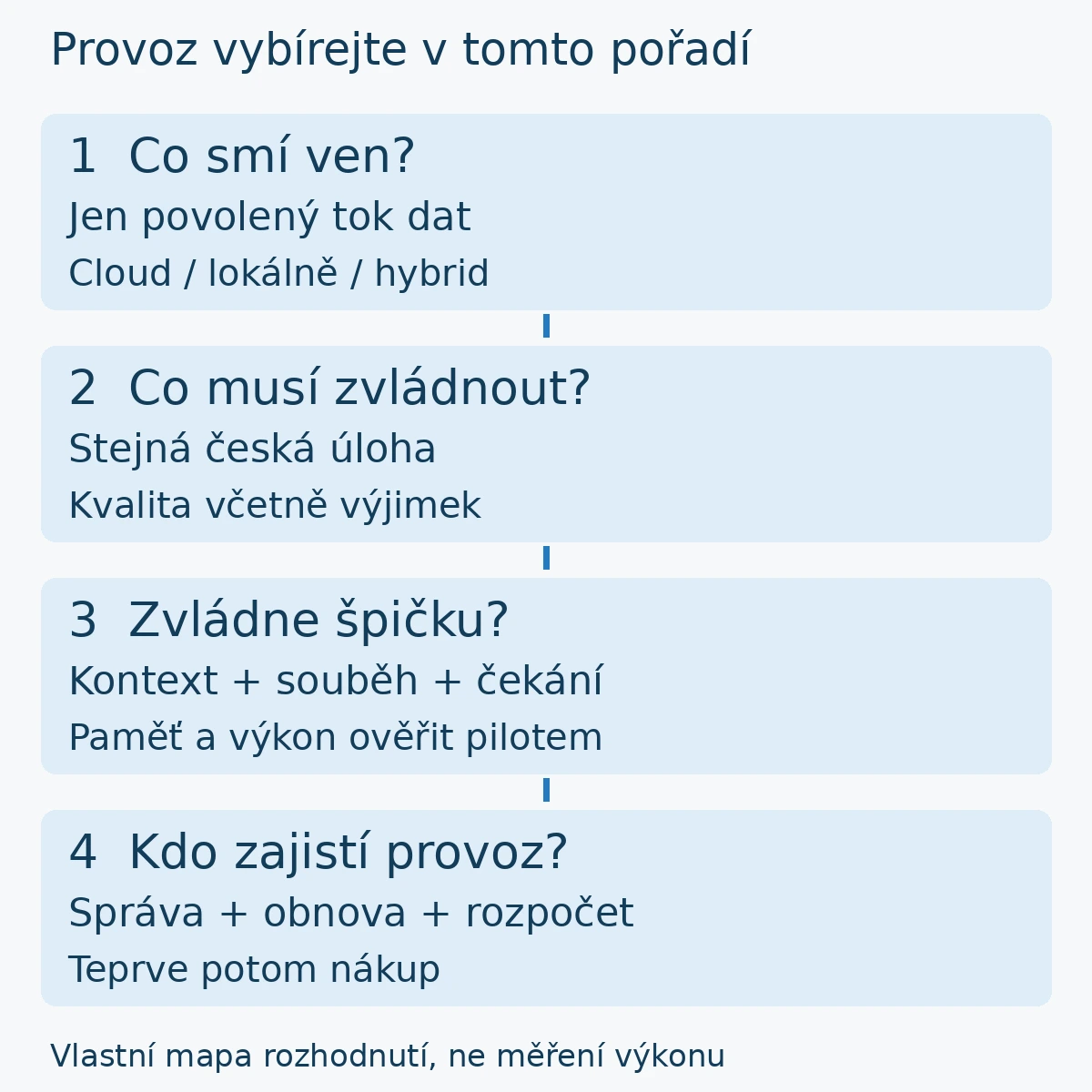
Choose representative Czech-language tasks
For comparison, prepare the same brief, source materials and acceptance criteria. Examples include answering a question from an internal policy, summarizing a Czech document containing an exception, and extracting several fields into an agreed format. Add a case where the source does not contain the answer. These are proposed pilot tasks, not claims that a particular model was tested here.
For each case, specify the expected evidence and an unacceptable error. Elegant Czech cannot compensate for a lost condition, and correct JSON formatting does not confirm the correct amount. A human evaluator should also assess terminology, sources and whether the system should decline to answer. Include ordinary and long inputs and difficult cases, not just an easy-to-present demo.
The record must capture the exact model, weight revision, quantization, chat template, generation settings and output limit. For models with a reasoning mode, record whether it was enabled. Otherwise you may unknowingly compare a short direct answer with lengthy reasoning. A model card’s multilingual-support claim is not evidence of quality on your Czech documents.
If you are still looking for an end-user application, see the AI tools overview. Here we address a different decision: where inference will run and who is responsible for operating it. The article on how AI understands text explains the basics of context; supplying your own sources also requires distinguishing RAG from the model itself.
Check the license, weight memory and KV cache
Downloadable does not mean unconditional. For the specific Qwen3-8B model, the model card lists 8.2 billion parameters and the Apache 2.0 license. That license includes obligations, particularly for redistribution, preserving notices and marking changes. It cannot automatically be attributed to every model of the same brand. Similarly, the Gemma terms explicitly distinguish models listed in the appendix from Gemma 4, for which they reference a different license. Check the specific artifact and intended use, not the generic word “open.”
The memory budget consists of weights, runtime working memory, KV cache and system headroom. KV cache retains intermediate attention results for processed tokens; it can grow substantially with longer contexts and additional concurrent requests. File size on disk is therefore not the size of the entire running system.
For perspective, 8.2 billion parameters multiplied by two bytes in a 16-bit representation gives roughly 16.4 GB for weights alone. An idealized four-bit calculation gives 4.10 GB, but actual quantization adds other information and may affect quality. Neither calculation determines the required card or speed. GB here are decimal; GiB below denotes units of 2^30 bytes.
The Qwen3-8B configuration has 36 layers, eight KV heads and a head dimension of 128. For a simple full KV cache using two bytes per value, the formula is 2 × 36 × 8 × 128 × token count × number of independent sequences × 2 bytes. The initial two represents keys and values. At 8,192 tokens and one sequence, that is 1.125 GiB; for four sequences of 32,768 tokens, it is already 18 GiB. This is an analytical estimate without prefix sharing, cache quantization, allocation overhead or other optimizations, not a consumption measurement. It does not apply unchanged to every architecture.
The model card distinguishes a native context of 32,768 tokens from extension to 131,072 using YaRN. A longer supported context does not tell you how many such requests your machine can serve. llama.cpp documents multiple hardware backends, quantization and combined CPU/GPU inference. CPU is therefore not universally unusable, but its acceptability depends on the task and waiting time. vLLM describes distributing a model across GPUs and estimating concurrency from KV-cache capacity. Such an estimate is not measured latency under load. Choose a runtime that matches the actual hardware and supported model; none is installed here.
Measure concurrency and the cost of an acceptable output
Concurrency is neither employee count nor the daily average number of queries. For a future business pilot, prepare a normal workload and a controlled peak. Track queue time, time to first token, time to the complete answer, failed requests and memory. Record distributions, such as the median and 95th percentile with observation counts. Include a run without a warm cache. Agree waiting-time and error-rate targets according to the user’s work, not an attractive vendor number.
The published Qwen2.5 benchmark shows why this matters. Its tables report the following figures for Qwen2.5-7B-Instruct. These are older external results available when checked on November 18, 2026; the page does not state the exact measurement date. They are not a current ranking or measurements of the Qwen3-8B discussed above.
On mobile, scroll the table horizontally; after focusing the region with Tab, use the arrow keys.
| Runtime | Input (tokens) | Output (tokens) | Speed (tokens/s) | GPU memory (GB) |
|---|---|---|---|---|
| Transformers | 1 | 2 048 | 40.38 | 14.38 |
| Transformers | 30 720 | 2 048 | 18.83 | 19.97 |
| vLLM 0.6.3 | 1 | 2 048 | 84.28 | not reported |
| vLLM 0.6.3 | 30 720 | 2 048 | 70.33 | not reported |
All four rows concern one NVIDIA A100 80GB, BF16, batch size 1 and generation of 2,048 output tokens. For Transformers, the source lists CUDA 12.1, PyTorch 2.3.1, Flash Attention 2.5.8 and Transformers 4.46.0; for vLLM, version 0.6.3, PyTorch 2.4.0 and Flash Attention 2.6.3, with the same CUDA and Transformers versions. Default vLLM settings are gpu_memory_utilization=0.9, max_model_len=32768 and enforce_eager=False. The source does not report vLLM memory because it is preallocated.
For Transformers, reported GPU memory increases and speed falls with longer input. Changing the runtime also changes the figures on the same card. That is a useful warning against buying on the basis of a single tokens/s figure. These data do not tell us response times for eight simultaneous users, Czech answer quality or time to first token. Nor do they tell us your server’s performance. Missing values cannot be calculated by simple multiplication.
For an economic comparison, use cost per accepted output: all costs of that option over the same period divided by the number of outputs passing the agreed review. Costs include failed attempts, retries and corrections. If only 800 of 1,000 attempts passed, divide costs by 800, not 1,000. That explains the denominator; it is not a measured model success rate.
Include administration, monitoring and recovery
A cheaper token does not automatically mean a cheaper service. Total cost of ownership, or TCO, should combine acquisition and setup with ongoing operation. Include model and runtime updates, monitoring, backups, quality checks and recovery after outages. With your own machine, a lower API bill can be exchanged for administrator time and responsibility for availability.
The following is a transparent budget illustration in USD, excluding taxes, currency conversion and financing. The only externally sourced rate is OpenAI Standard for GPT-6.1 Sol: USD 2 per million input tokens and USD 10 per million output tokens in short context. I assume 20,000 requests per month, each with 6,000 input and 1,000 billed output tokens, without caching, tools or retries, and with the 10% European regional surcharge. The result is (120 million × 2 + 20 million × 10) × 1.10 = USD 484 for tokens. This is neither a ChatGPT subscription price nor an estimate of this model’s performance.
All other amounts are chosen hypothetical assumptions, not verified market quotes or our actual consumption. For the local option, I assume a USD 6,000 acquisition budget spread over 36 months, 176 hours per month averaging 0.20 kW and the remaining 544 hours at 0.04 kW. At an assumed electricity price of USD 0.25/kWh, that is USD 14.24 per month. Administration is assumed to take four hours at USD 50, with USD 30 for monitoring and backup. This does not size a specific machine or demonstrate that a local model can handle the stated volume.
I allocate two administration hours at USD 50 and USD 30 for operational monitoring to the cloud option. The hybrid includes the entire local operation, 60% of requests to the same API and two additional hours for routing administration. The 40% local-request share is a working assumption, not a classification or measurement result. All options also have a common monthly base of USD 500: USD 2,400 for initial setup spread over 12 months, USD 100 for the application and retrieval layer, and four hours of human review at USD 50.
On mobile, scroll the table horizontally; after focusing the region with Tab, use the arrow keys.
| Item | Cloud API | Local | Hybrid 40/60 |
|---|---|---|---|
| EU API tokens | 484.00 | 0.00 | 290.40 |
| Local hardware / 36 months | 0.00 | 166.67 | 166.67 |
| Local electricity | 0.00 | 14.24 | 14.24 |
| Option-specific administration | 100.00 | 200.00 | 300.00 |
| Option-specific monitoring and backup | 30.00 | 30.00 | 30.00 |
| Common base | 500.00 | 500.00 | 500.00 |
| Total | 1,114.00 | 910.91 | 1,301.31 |
The table is a calculation under stated assumptions, not a contest with a winner. The local option has not yet demonstrated capacity or equal quality; the hybrid has not demonstrated that it is permitted to send those queries to the cloud. In a hypothetical reduction to 2,000 requests, the cloud total falls to USD 678.40; at 200,000 it rises to USD 5,470. These points change only API arithmetic while holding other assumptions constant. They do not establish that the local machine can serve those volumes or that administration and review will actually stay constant as usage grows.
Before finalizing a budget, replace hypothetical items with quotes and pilot results. You may need to add migration, networking and cooling, spare capacity, on-call support, security and legal work, a different implementation scope, paid licenses or more frequent output review. The table does not price these separately. For a critical process, request both the cost and time of recovery; one workstation without a replacement is not the same service as operation with an agreed availability level.
For a hybrid, enforce routing outside the prompt
A hybrid works only if the data-path decision happens before transmission. “Send sensitive queries locally” is not enough if a cloud model must first evaluate that instruction together with the sensitive text. At that point, the data has already left the infrastructure.
Use an enforced application-layer policy: a permitted data label and user identity determine eligible backends, the access key permits only that route and network rules restrict outbound traffic. Unclear or prohibited cases stop or go through a local path, not automatically to a “smarter” cloud fallback. Extend restrictions to OCR, embeddings, tools and logs. This is an architecture proposal to verify, not a completed security certification.
Before expanding the pilot, close the following points:
- Quality: the same Czech-language sample, known correct sources, expected refusal and a separate human evaluator.
- Capacity: exact model and runtime versions, quantization, input and output lengths, peak concurrency, queue, first token, complete answer and memory.
- Data: permitted regions, account and contractual arrangements, feature-specific retention, the entire flow including subcontractors and prohibited outbound paths.
- Recovery: an update owner, error monitoring, tested restoration from backup and a procedure for an unavailable backend.
- Decision: acceptable error rates and waiting time, cost per usable output and predefined conditions for continuing or stopping.
If a candidate fails a non-negotiable condition, reject it even if it is cheaper. If it meets all essential requirements, choose on the basis of the entire operation and the ability to change vendors. That is how to avoid a purchase that is technically impressive but mismatched to your company’s work.
Choose AI deployment for the work it needs to handle
Deciding between cloud and a self-hosted model? I can help clarify tasks, data boundaries and pilot criteria so your technical lead receives a comparable brief. Tell me what AI should solve in your company; do not send sensitive materials through the contact form.