


Brief an AI brand visual as an output you can check, not a wish to “make it look professional.” Define in advance what may change, which elements must stay the same and who will decide whether the result is usable. Then open the actual export: a convincing response from the generator does not mean the lettering, product or crop is correct.
This workflow is for a small marketing team that needs an illustration without losing brand identity. It includes a small, real demonstration: an original drawing of an explicitly fictional mug and two outputs from the same brief. It is not a comparison of all generators, a client project or evidence of product-photography accuracy.
Start with the intended use and what must not change
An article illustration needs different rules from the main product photograph in an online store. Inventing the setting may be acceptable in an illustration. For a product being sold, an image must not silently change its shape, material, accessories or use. If you cannot verify that fidelity, retain the real product from a verified photograph and restrict generation to an appropriate part of the scene, or use conventional graphic production.



Divide the brief into fixed elements and room for creative proposals. Fixed elements might include lettering, logo proportions, the number of buttons, packaging shape and prohibited claims. Lighting, background or decorative placement may be flexible. Do not let the tool decide which brand colors are merely approximate or which word it can shorten. Recognizability and the actual offering are discussed in Brand and SEO.
Specify the intended use, dimensions, permitted references, immutable features, allowed changes and approver. For a web thumbnail, include the actual template crop. A face or product can be complete in the original and still disappear on mobile. A similar approach to briefing, but for text, is covered in the content brief with a template.
References, generation and templates have different jobs
Define the role of every input image. A product photograph supplies geometry and details. A color swatch defines the palette. A composition reference shows placement; it does not automatically grant permission to copy someone else’s face, logo or entire work. An exact logo is a production asset; it need not be redrawn just because the rest of the scene is AI-generated.
Fresh generation suits exploring a concept or creating an explicitly labeled illustration. Choose editing when the image is already good and you need to change a specific area. State “change only” and “preserve” separately. A template or layout with separate layers is often more practical when prices, dates, longer text or an exact wordmark need regular updates. The generator need not handle the whole job in one image.
After editing, compare the areas that were supposed to remain unchanged, too. The instruction “only change the background” does not itself prove that the tool preserved the product. For a real portrait, you need the relevant consents and likeness rights as well as permission to use the photograph. The test below therefore contains no people or client materials. The opening editorial illustration is a separate synthetic series visual, not part of the product test or evidence of an actual event.
An original demonstration: one fictional mug, the same brief twice
An original flat reference drawing was created for this article under the brand name MODRÝ UZEL. The name, product and brief are fictional; this is not a client, an existing offering or a trademark clearance. The mug has a white cylindrical body, a single blue handle on the right when facing the front print, two narrow blue rings near the base and an orange square to the left of the name. “350 ml” is part of the fictional print, not the measured capacity of a real vessel.
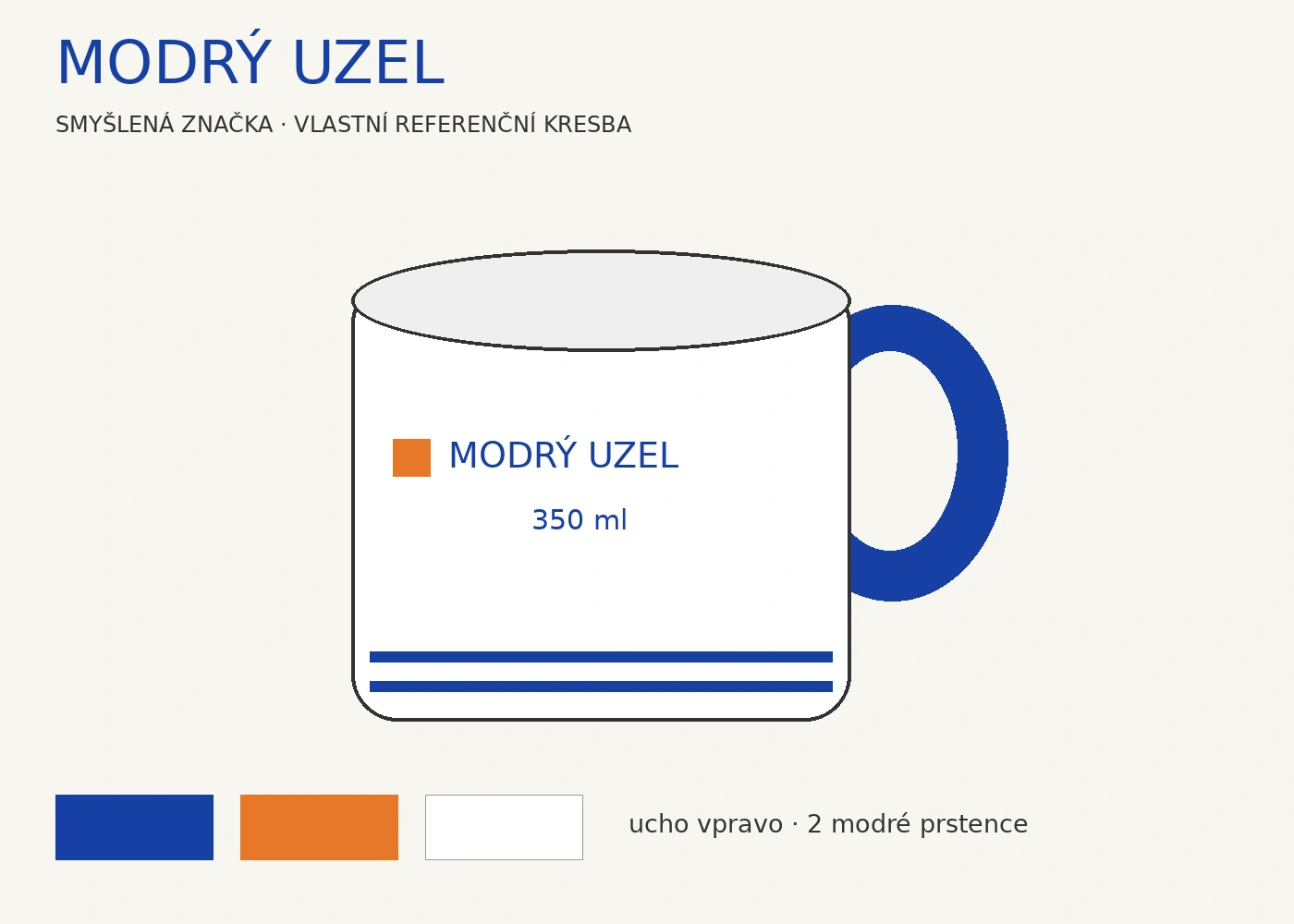
On November 18, 2026, two separate real requests were made through the installed Hermes image provider OpenAI (Codex auth), authenticated using Codex OAuth. Both received the same drawing and exactly the same brief below. There was no fine-tuning, comparison with another provider or selection from dozens of undisclosed attempts.
Create one photorealistic advertising product illustration for the explicitly fictional brand MODRÝ UZEL. The input is our own flat technical drawing and color reference, not a photograph of a real product. Transfer the precisely defined product into a realistic white ceramic mug: a straight cylindrical shape, one cobalt-blue handle on the right when facing the front print, exactly two narrow cobalt-blue rings near the base. On the front, a small orange square to the left of the exact blue lettering “MODRÝ UZEL”; beneath it, exactly “350 ml”. No other words, numbers, logos or another manufacturer’s branding. The mug stands on a light wooden table in a lived-in industrial studio, with one plant in the softly blurred background. Soft daylight, the main mug in sharp focus in a three-quarter view so that the entire lettering and handle are legible. No people, hands, packaging or other mugs. Preserve white, cobalt #173FA3 and orange #E87829. Horizontal 3:2, the entire product inside the central 2:1 safe area. Do not show the reference sheet itself or its explanatory notes. The output is intended as an unpublished illustration and review demonstration, not evidence that the product exists.
Important technical caveat: the client requested the gpt-image-2-medium profile, dimensions of 1536 × 1024 and medium quality. Both returned PNGs are 1536 × 1024 pixels, but the server reported low quality for A and medium for B. The response did not identify the actual image-engine version. According to the Hermes documentation, this path is controlled by the server; the selected name does not prove a particular engine. The demonstration therefore verifies this access mode and these two outputs, not the performance of a precisely identified GPT Image version. Nor does it guarantee that the requested quality stayed the same between attempts.
Check text, product and consistency separately
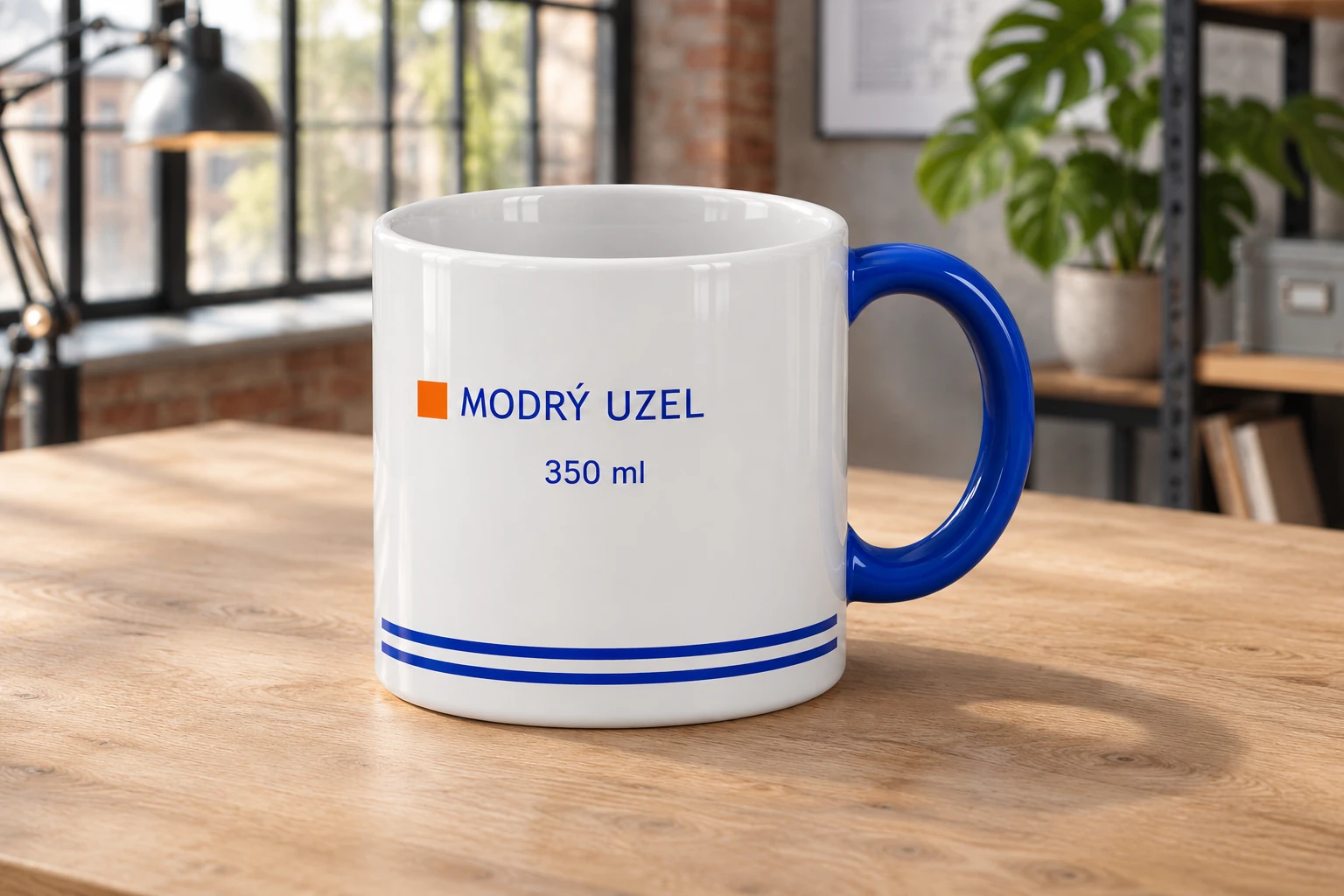
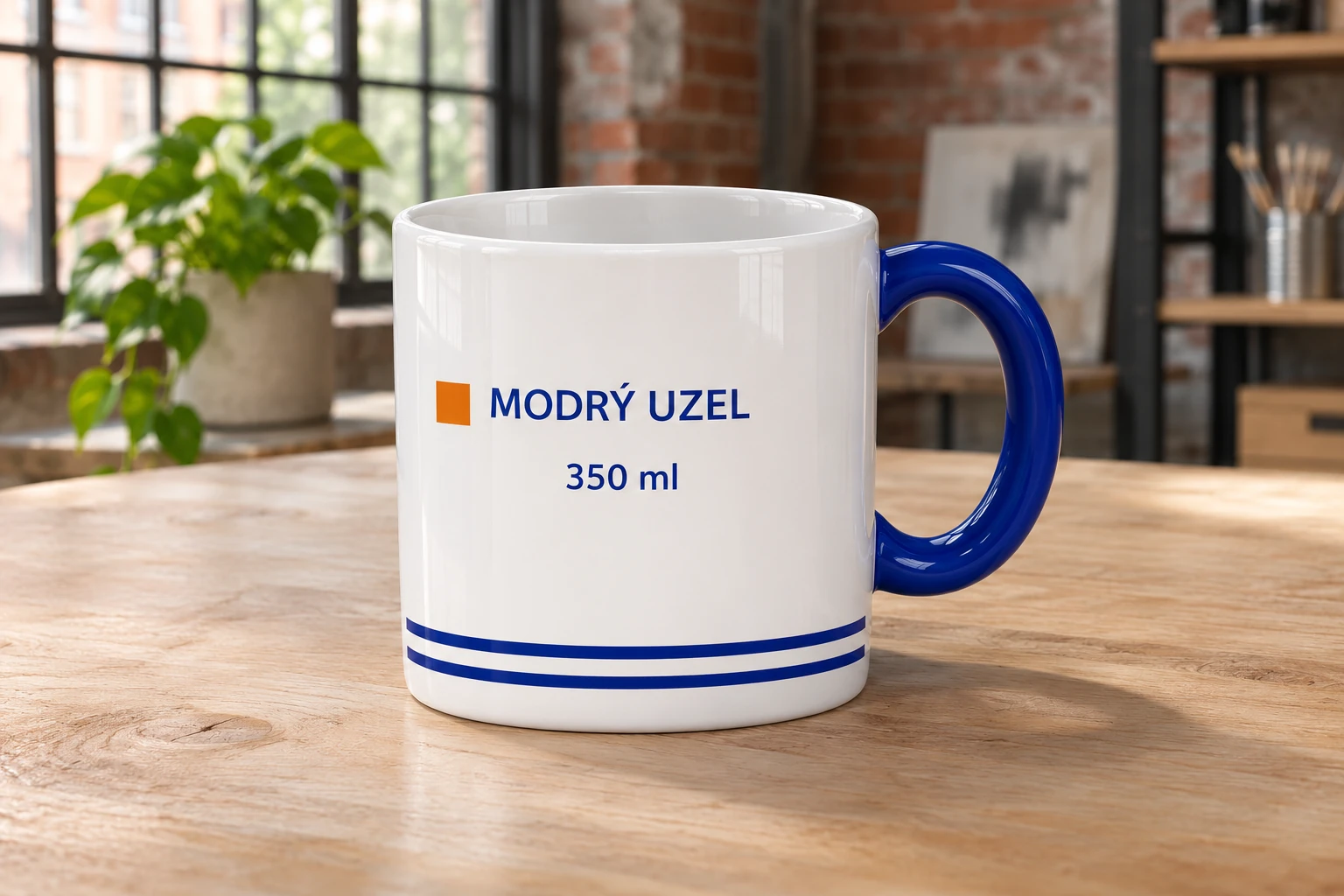
Both originals legibly show “MODRÝ UZEL”, including the acute accent over Ý, with “350 ml” beneath it. One blue handle on the right and two blue rings were retained. This small demonstration therefore produced no documented text error or incorrect count of these elements. It would be dishonest to add such errors to the findings merely because the article is about checking defects.
An initial assessment of A raised a suspicion that the orange square was too narrow. A close-up of the original, however, shows the mark on the curved left-hand part of the body. Image projection alone cannot reliably separate a shape error from perspective. The finding is therefore not “a proven incorrect logo” but an unresolved check of exact geometry. For a job requiring an immutable logo, I would not approve this point on overall impression alone; a more frontal check and an exact graphic asset would help, or the print could be finished outside the generator.
You can scroll the detail below horizontally, including with the arrow keys after focusing the region with Tab. The surrounding paragraphs also state the text and review conclusion.
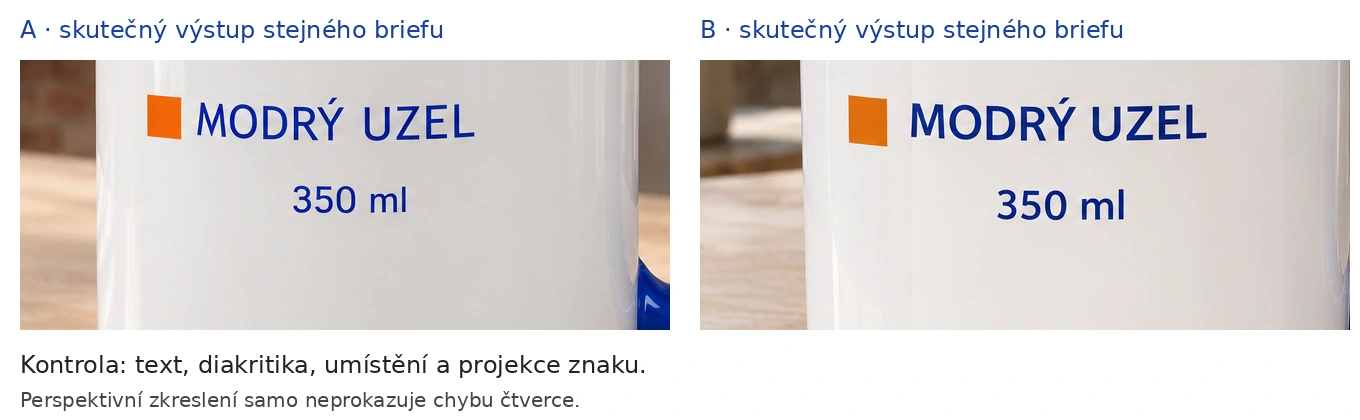
The background, lighting, proportions of the depicted handle and placement of the print in the image differ between A and B. Preserving a few identifying features does not prove identical product construction or an exact brand color. No metrological or color-calibrated inspection was performed. Two outputs are also insufficient to estimate long-term success rates. The review here examined actual pixels using an AI image tool; it was not a user study or approval by a graphic designer.
For acceptance, record an observation, consequence and decision for each area. “A different shade in a highlight” may need verification, whereas “a different product model number” would be an immediate reason to stop use. Do not hide uncertainty behind an aggregate score. In this demonstration, both images are usable for explaining how to review a fictional illustration; neither establishes fidelity to a real mug being sold.
- Text: read every inscription, accent, number and unit. Check small lettering in the original file, not just a thumbnail gallery.
- Product: compare shape, component counts, material, joints and accessories with the confirmed reference. Check details behind a hand or in reflections, too.
- Consistency: place variants side by side and define permitted differences. A similar mood is not identical identity, and repeating a prompt does not lock appearance.
- Use: open the export at the intended size and crop. Check readability, complete key objects and surrounding text, not just pixel count.
A reference image is not model fine-tuning
Adding a drawing to a generator supplies reference material for that request. It does not by itself create a custom model. This test used image input; no training was run. Do not infer rules for the provider’s subsequent use of inputs from that, though: those are set by the contract and account settings, not the word “reference.”
According to the Diffusers documentation, LoRA is a training technique that adds and trains smaller additional weights. It is a different operation from attaching an image to a single edit. It entails work on a dataset, model licensing and output checks. Owning the photographs in a dataset does not by itself mean zero legal risk, exclusive rights to a style or automatic protection for every output.
Consider fine-tuning only when you have a specific recurring problem and know how you will evaluate improvement. An approved template or working with an original photograph may be better for exact lettering or stable product geometry. This article did not test fine-tuning or promise savings from it. If you are still choosing an application, use the AI tools overview; this article is about accepting outputs, not ranking products.
Check rights and the specific account’s data arrangements
Separate three questions: may you provide the input, may you use the depicted likeness or brand, and under what conditions may you use the output? Finding a photograph online does not resolve even the first. With your own photograph, other people’s rights or restrictions on a depicted work may still apply. Do not request imitation of someone else’s identity or a specific work without appropriate permissions. Have disputed uses in a major campaign assessed by a lawyer; the following summary is not a legal guarantee.
OpenAI’s European terms state in the Content section that, as between the user and OpenAI and to the extent permitted by law, the user retains rights to the input and owns the output. They also require necessary rights and permissions for inputs and warn that other people may receive similar outputs. This is not confirmation of copyright protection for every AI image or trademark clearance. The Image and Video Capabilities section of the Service Terms also requires explicit consent and necessary rights to reproduce a person’s likeness.
The test used Codex OAuth, not the paid OpenAI API. The official description of using Codex with a ChatGPT account ties this access to the terms and policies of the relevant account or the applicable business agreement. A login alone does not establish API terms, zero retention or entitlement to a particular image model. There was no basis for claiming that the test account has business protections or provides free unlimited generation. The test did not switch to another provider or a paid API.
The documentation on using data for training distinguishes personal accounts from business services. For personal accounts, it describes possible content use and an option to opt out of training; it says the ChatGPT preference also applies to Codex conversations. The business rule against training on data must not be extended to a personal subscription. A public description is not proof of our test account’s current settings; only original, non-client, fictional material was therefore used for the product demonstration. Disabling training is also not the same as zero retention. The Privacy Policy describes other processing and retention purposes; a specific business use requires its own assessment.
The terms were researched on November 18, 2026. Website protection blocked direct access from the test environment, so the legal texts were read through text extraction of the primary URLs. Direct browser verification of those pages was unsuccessful. Before production use, verify the current agreement and your actual account settings; this test does not claim to audit them.
Approve a specific export and its intended use
Keep the original, exact brief, permitted inputs, date, known mode and returned technical details. Add findings, corrections and the specific approved file. If the engine is unidentified, say so. If requested and returned quality differ, do not erase the discrepancy from the record. Without this trail, you will not later know what you are repeating.
The demonstration retained both original 1536 × 1024 PNGs and created separate WebP files at the same dimensions for the article. The export was not upscaled and the print was not manually corrected. These are not vector logos, print-ready files or approved final advertisements. Small text needs checking again after conversion; changing the extension does not itself guarantee appropriate compression or legibility. Address production requirements for print separately.
For recurring production, track the number of accepted proposals, reasons for rejection and total preparation, review and correction time. Only your own records will establish whether the workflow helps. A quickly generated image saves nothing if a designer then rebuilds it entirely. Approving a visual is also not automatic permission to publish it on every channel.
Want an AI visual-production workflow you can actually review?
I can help define a pilot, prepare a brief and agree what marketing, the designer and the asset owner each check. Tell me what visuals your team produces and where acceptance reviews lose time. We will agree the scope of any implementation for your situation; I do not replace legal assessment or specialist product inspection.




