


An AI avatar makes sense for video localization when you need to deliver an approved message repeatedly in other languages and having a speaker on screen helps explain it. For a screen recording, subtitles or dubbing are often enough. For product training, a digital presenter can be useful. In neither case, however, does a natural-looking face prove that the translation is correct.
First decide what an international viewer should understand or do. Only then consider the avatar. If your company cannot serve customers in that language or keep its instructions up to date, more videos may create work rather than value. The following workflow draws on official documentation and terms checked on November 19, 2026. It is not an original test of generation, translation quality or voice cloning.
When subtitles are enough, when to dub and when to use an AI avatar
Subtitles retain the original speech and add translated text. They are a sensible starting point for an audience that can read without simultaneously following a dense interface. In a technical tutorial, though, reading can compete with attention to the screen. Check not just the language but also line length, timing and whether subtitles cover important elements.


Dubbing replaces or supplements the spoken audio. It suits a screencast, for example, where viewers need to follow individual steps and the author’s face is not important. Lip synchronization, or lip-sync, also adapts a visible speaker’s mouth movements to the new speech. If nobody appears in the video, you do not need that visual adjustment. Dubbing does not require the resulting voice to imitate a particular person.
An AI avatar is a digital presenter that can deliver a script. It might be a licensed character from a library or a digital likeness of a real person. That is a different workflow from translating an existing recording, even if a vendor offers both in the same application. An avatar makes more sense for recurring training and explanations whose wording changes regularly than for a record of an actual event. A generated performance must not be presented as evidence that an event really happened.
- Need to make existing content accessible, with visuals that speak for themselves? Start with subtitles.
- Must viewers watch the visuals while understanding the instructions? Consider dubbing without changing the face.
- Is a visible speaker important, and are you only changing the language of a finished video? Consider translation with lip-sync.
- Need to change both the script and the presentation language repeatedly? Assess an avatar, but also how you will manage its likeness, rights and individual versions.
This is not a ranking from inferior to superior technology. You can add subtitles to dubbing or an avatar, too. What matters is whether the format helps a specific audience and whether the team can review it. For a broader choice of applications, see the overview of AI tools by work task; here we focus on video localization.
The brief must define the audience, language and responsibilities
Before choosing a tool, write a short brief: who the video serves, what problem it solves, where it will be available and what viewers should be able to do afterward. “Translate into English” is not enough. Internal training for service technicians needs a different approach from a public product presentation. Specify the target market, language variant, assumed knowledge and follow-up support.
Distinguish the person responsible for subject-matter accuracy, the language reviewer and the person approving publication. One person may fill several roles, but it must be clear who made the decision on a particular version. Fluent German is not enough for technical or safety instructions: the reviewer must also understand the product and the consequences of an incorrect instruction.
Start with one genuinely needed video and one language variant. That is a recommendation for your project, not an experiment conducted for this article. The aim is to discover where corrections arise and who will handle them before building an entire catalog. Market selection and its connection to your offering are covered in more detail in international SEO and website localization; a video alone will not resolve those questions.
An approved script and terminology do most of the work
The input text must be factually correct before translation. Expand vague references such as “click here” if they make no sense without looking at the visuals. Correct automatic transcripts, mark product names and check numbers, units, negatives and conditions. Shortening for timing must not remove wording such as “administrators only” or “after disconnecting the power.”
Prepare a small glossary: the original term, approved target expression, rules for leaving brand names untranslated, pronunciation and the decision owner. Written form and pronunciation are different things. Keeping a product name in the text does not guarantee that the voice will pronounce it correctly. The same applies to names, abbreviations and model designations.
Illustrative example, not a client project: a Czech supplier of a fictional Model A device is preparing German first-start instructions. The brief specifies that Model A must not be translated, safety steps must not be shortened and labels must match the German interface. The translator prepares terminology, a product specialist checks meaning and a language reviewer assesses clarity. If the device still displays a Czech menu, the job is not finished just because the avatar speaks German.
Map the script to the visuals segment by segment: what is said, what is visible, which subtitle appears and where a new edit may be needed. A longer translation may not fit the original pause. The solution may be rephrasing without changing the meaning or adjusting the edit, not automatically speeding up the voice. Keep the approved source text and target version so that the next change has a clear scope.
What HeyGen currently documents—and what that does not establish
HeyGen is a specific workflow example here, not a recommendation for every company. Its Video Translation documentation distinguishes Audio Only without lip-sync from Speed and Precision modes that adjust lip movements. It describes different requirements for demanding shots, changing speakers or an obscured face than for someone speaking directly to camera. These are vendor features and recommendations, not quality differences measured here.
A less obvious limitation matters to the decision: according to the documentation, Video Translation does not translate text embedded in the image, such as graphics or original burned-in subtitles. Translated speech may therefore still accompany a Czech diagram or an old price list. The documentation also distinguishes source and target languages and flags the issue of multiple spoken languages in the input video. Do not mistake a list of target languages for automatic support for any input.
The Proofread, or Review & Edit, feature lets you edit the translated script, voice and timing before the final video, according to the vendor. As of the research date, the documentation lists it for Pro, Business, Team and Enterprise; do not assume it comes with every plan. Preview plays translated audio against the original visuals without lip-sync. Only Result is the final rendered video, with lip-sync if selected. Approving an audio preview is therefore not a review of the final mouth movements and expressions.
For recurring terminology, there is Brand Glossary. The documentation distinguishes forced translations, do-not-translate entries and pronunciation rules. The instructions say you must select the glossary when creating the Proofread project; it cannot simply be added to an existing one. A one-off pronunciation correction in one segment also does not fix every other occurrence. Details like these matter more to repeatability than an advertised language count.
Before buying, confirm the exact mode, source and target languages, script editing, export, access management and correction costs. The number of credits is not the number of finished, approved minutes. I am not quoting a universal price or savings percentage: these depend on the plan, selected mode, number of languages and repeat processing. Product-page claims of perfect synchronization or speed are not guarantees for your video.
Consent to use a likeness does not settle rights and data issues
Before uploading material for a digital likeness of a real person, clarify which organization, languages, purposes and period its use covers. The speaker must understand that the avatar may deliver words they never personally recorded. Do not automatically treat consent to record an interview as permission to create new advertising performances. Alongside likeness rights, address rights to the recording, photograph, music and other materials used.
In its avatar rules, HeyGen requires the depicted person’s explicit consent to create a custom avatar, as well as authorization to use and share it. For a video-based Digital Twin, it also describes a separate consent video that the person concerned must record. This product-level check does not replace an assessment of your particular legal and contractual relationship.
Voice cloning is an optional part of some workflows, not a requirement for every localization. If you use it, HeyGen’s voice terms require prior explicit and informed permission with a defined scope of use. Under those terms, owning a recording or employing the speaker does not by itself authorize cloning. You can instead choose a voice for which you hold an appropriate license; you still need to check its scope.
Also check the terms for the specific plan. The wording checked during research, marked as updated on October 16, 2026, restricts Free Plan outputs to personal non-commercial and internal evaluation use; it does not grant general permission for client work or advertising. For paid plans, it also addresses the vendor’s license to uploaded and generated content, including use to improve models. For business materials, therefore, check the full contractual arrangement, any different enterprise agreement and data-processing terms—not just the Export button.
For personal data, distinguish permission to use a likeness from the legal basis for processing. The GDPR addresses the legal basis in Article 6, conditions for consent in Article 7, controller–processor relationships in Article 28 and transfers to third countries in Chapter V. If processing relies on consent, it must be possible to withdraw it; that does not retroactively affect the lawfulness of earlier consent-based processing. Have the specific arrangement assessed by the responsible person or a lawyer, especially in an employment relationship. This article is not a legal opinion.
Viewers should know they are seeing an altered or synthetic performance
As a practical editorial rule, I recommend clearly labeling both digital presenters and artificial alterations of a real speaker. Describe the actual intervention: for example, “This video uses an AI avatar” or “Audio and lip movements were adjusted using AI for the German version.” The label “translated” may not explain that the person shown never actually delivered that speech.
The legal obligation is not identical to this broader recommendation. Article 50(4) of the AI Act requires deployers to disclose artificial generation or manipulation of content constituting a deep fake. The definition and context of the particular video matter; not every avatar is automatically a deep fake. Paragraph 5 requires clear, distinguishable information no later than the first exposure to the content. The European Commission states that Article 50 applies from August 2, 2026. Human review of a translation does not itself replace the duty to label a video covered by these rules.
Providers’ technical machine-readable marking of outputs under paragraph 2 is a different layer from informing viewers. Do not remove available provenance markers or assume a watermark alone meets every obligation. Check on each channel whether labeling survives export, editing and re-uploading. Assess the legal scope, including possible exceptions, for the particular use.
Review the complete export before publication
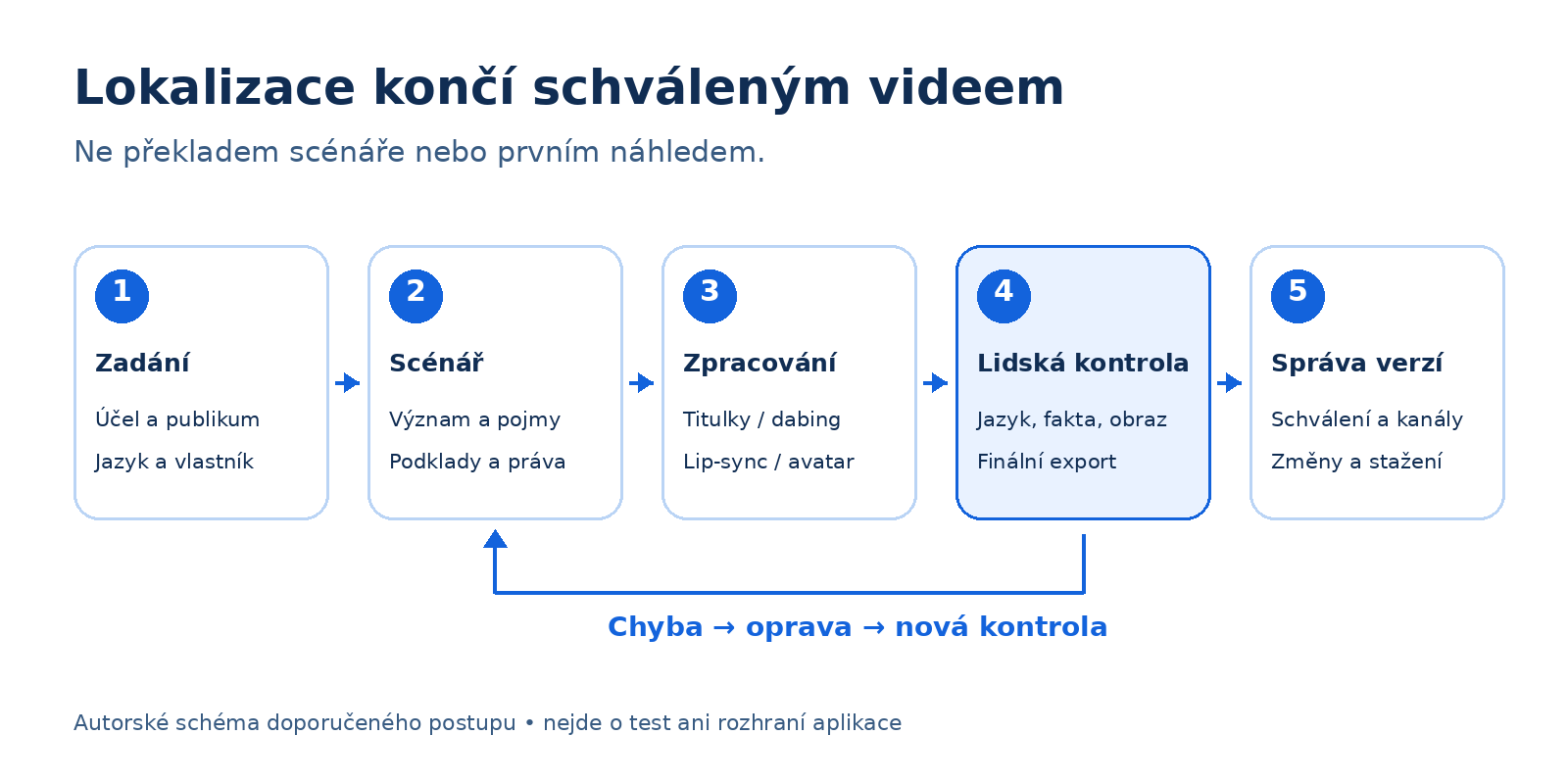
Have the language version reviewed by someone with the necessary command of the target language; where complexity warrants it, involve a native speaker with subject knowledge. Review the final file, not just the translated script. Correct text can accompany a different audio track, incorrect subtitles or an outdated image. For high-risk instructions, require subject-matter approval as well.
- Meaning: have conditions, negatives, step order and degree of certainty been preserved? Has a promise appeared that the company cannot fulfill?
- Terminology and audio: are names, units, numerical data, pronunciation and the assignment of lines to the correct speaker consistent?
- Visuals: do labels, graphics and the actual interface match the speech? If lips were altered, do the mouth, teeth or transitions between shots undermine the result?
- Subtitles and accessibility: are they synchronized, readable and clear of important controls? Is the message understandable with the sound off?
- Rights and transparency: do permissions cover this language version, channel and purpose? Is the AI disclosure visible where the video actually plays?
- Approval: does the export match the latest approved version, and is there a record of who released it? Have working or confidential materials been left in public shares?
Log errors with a timestamp, description and expected correction. “It sounds odd” is hard to hand over; “the product name is pronounced differently in this segment from the approved glossary” gives someone a concrete task. Review the new export again after correction. A successful review of one language version does not approve all the others.
After release, you need an owner for changes, not just a video link
For each video, retain the source script, translation, glossary, related permissions, approvals, final file and list of publication locations. Product changes or a speaker’s departure can then be handled against specific versions. Also define who can commission or create another output; access to a person’s digital likeness should not amount to a freely shared login password.
Prepare a suspension and takedown procedure. HeyGen’s custom-avatar rules require honoring the depicted person’s request to remove published likenesses; its voice terms similarly address termination of permission and withdrawal. Deleting a vendor project does not itself guarantee that copies disappear from your channels or from other recipients. Distribution records are therefore a practical necessity, not extra bureaucracy.
Evaluate success against the purpose: can people complete the task described, where do they need clarification, and how many corrections does each update require? Include translation, review, repeat processing and version management in costs. Exported minutes are not a measure of business value. If the video is intended for a public channel, address its topic, packaging and evaluation using YouTube SEO principles as well, rather than the avatar’s language count.
Need to decide where video localization makes sense?
Bring one typical video, a target market and details of who can approve content. In a consultation, we can work through a suitable scope, responsibilities and a brief for your team or supplier. The goal is a sustainable workflow, not an avatar at any cost.




