

Do not assess company data solely by a chatbot’s brand or the country hosting its server. Map what leaves the specific account, which service processes the content and where additional copies are created. A file may first be converted to text, then pass through retrieval and a model, and finally end up in a history, error log or backup.
Banning unapproved applications is no substitute for this map. You need to find out why people use them, offer a workable approved route and assign ownership of the rules. The following process is a working aid for marketing, IT and data stewards, not a legal opinion or a security audit of a particular company.
Discover the real tasks without punishing employees
Shadow AI means using AI outside an approved, managed company process. It need not involve a free service: a paid personal account unknown to the organization can also cause problems. Conversely, simply using a publicly available application tells you nothing about the contract and settings of a specific company account.



Start with conversations about tasks, not by collecting private chats. Ask what people have summarized, translated or classified, where they get their source material and where they copy the result. Include browser extensions, meeting transcription tools and standalone PDF converters. They may receive the content before the chatbot does.
For an initial map, the task type, data category, product, account mode and required feature are enough. Do not request passwords or examples of real customer files. Explain the purpose of the conversation and how the records will be used. Any technical monitoring of employees has its own legal and organizational requirements; do not introduce it casually as part of a marketing workshop.
A conversation may reveal that people mainly need a simple way to summarize a long document. The answer may not be a new system, but an approved account, defined source material and an explanation of usage boundaries. If the official route cannot handle their task, however, a circular alone leaves the reason for bypassing the rules intact.
Classify the data and the access required
A single folder may contain a public product sheet, a non-public price list and an email from a specific customer. Do not automatically apply the same rules to the entire repository. For each process, describe the content required and what would happen if the wrong person gained access. Trade secrets and personal data are not the same thing, but one document can contain both.
A working classification might distinguish approved public data, internal operational data and specially restricted material. These are not statutory categories or automatic permission to use the cloud for the first two groups. Add the actual company rules, contractual restrictions and responsible role. Customer data is not yours to use freely simply because it is stored in your CRM.
Limit the input to what the task needs. To adjust the tone of a reply, a model usually does not need the entire order history. If you replace names with labels, record whether a reverse mapping exists and whether the person can be identified from context. Do not automatically call this anonymization. Even removing an email address may not be enough if the unique story of a particular job remains.
The EDPB’s December 2024 opinion on AI models emphasizes case-by-case assessment of model anonymity and the conditions for using personal data. The opinion concerns models and their development and deployment; it is not blanket approval to send pseudonymized documents to any service. Have the legal basis, processing roles and any transfers outside the EEA assessed against the actual flow.
Draw the entire flow, including OCR and logs
Record every recipient in the map, not just the main application. OCR converts an image or scan to text. An embedding service creates numerical representations for retrieval. A language model receives selected inputs and generates a response. Each step may have a different operator, location and retention period.
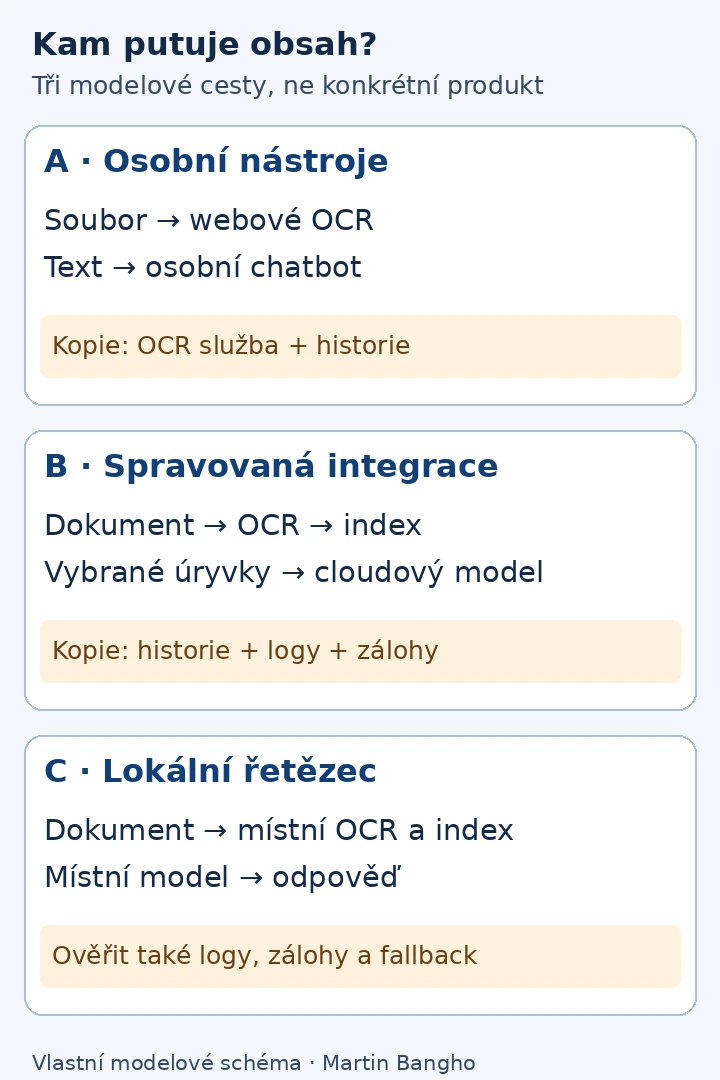
Illustrative flow A: an employee uploads a contract to a standalone web converter and pastes the extracted text into a personal chatbot. There are at least two external recipients of the content. Disabling training in the chatbot does not address what happened in the converter. Discovering a company alternative to the chatbot does not retrospectively remove earlier copies either.
Illustrative flow B: a managed application loads an authorized document, converts it using approved OCR, stores an index and sends selected excerpts to a cloud model. It returns the answer to the employee, but may also record the input and output in diagnostics. Check the storage region, model processing, log contents, backups and support access separately. One European region for the application does not prove that every step takes place in Europe.
Illustrative flow C: the document, OCR, index, model, logs and backups stay within the organization. But you must verify that they remain local when something fails, too. If the local model fails and the application switches to a cloud fallback, content may leave the permitted environment. A prompt saying “do not send sensitive data outside” is not a network restriction, and a cloud model should not first read a document to decide that it belongs with a local model.
Add the output route to the map: who receives a shared link, where an export is stored and whether the answer appears in an email or project tool. Protecting the source is not enough if you copy its contents into a less protected output. For tool permissions and independent actions, see MCP and AI agents in marketing; the aim here is a complete record of recipients and copies.
Check the account, retention, region and subprocessors
Retention is how long data is kept. Separate it from training: a promise not to use content for training does not mean the provider does not store it. Also distinguish user-visible history, application state, security records and backups. One “delete” button may not control every layer.
The Microsoft 365 Copilot documentation describes both restrictions on training foundation models on organizational data and the storage of interactions, including the prompt, response and citations. It refers administrators to Microsoft Purview for retention controls. A company therefore needs to verify not only the relevant license but also the permissions and retention policies actually configured. Respecting existing permissions will not fix a folder you accidentally shared too broadly.
For eligible Workspace editions, Google distinguishes Gemini in Workspace applications from the standalone Gemini app. For the Gemini app, it describes retention of new chats for up to 72 hours when history is off, to provide the service and process feedback. History off therefore does not mean zero retention. Workspace terms refer to the Cloud Data Processing Addendum; do not apply them to a personal account or another cloud product simply because they share the Gemini name.
OpenAI’s API also separates training, security logs and application state. Its documentation states that API data is not used for training unless the customer explicitly opts in, while abuse-monitoring logs are retained for up to 30 days by default, with specified exceptions. Zero Data Retention requires approval and has endpoint- and feature-specific restrictions. It is not a universal switch for every copy of the data or a rule for personal ChatGPT accounts.
For regions, distinguish storage location from compute location. When checked on November 18, 2026, the OpenAI API regional documentation defined the European region as the EEA and Switzerland, with support scoped by service and model. It explicitly distinguishes system data and transfers outside the service’s control. Do not rewrite a Europe label as “all data stays exclusively in the EU.” A similar label on another platform may have a different scope.
For each service, record the exact product and edition, contracting entity, applicable terms, relevant data-processing agreement, subprocessor list, configured region and check date. Attach evidence from administration or vendor confirmation for the specific account. Public documentation is a basis for questions, not proof of the actual configuration of your environment. Have a lawyer or data protection officer decide disputed transfers, not the region’s marketing label.
Introduce an approved alternative and verify deletion
A usable rule connects the task, permitted route and data boundary. For example: a reply based on a public product sheet may be drafted in an approved work account; a customer file must not be entered into a personal account; if sensitive material is needed, the employee contacts the designated process owner. This is an illustrative rule to adapt, not a ready-made internal policy.
For every approved route, assign an account administrator, data owner and incident contact. Employees must know what to do after a mistake: stop entering further content, report the service involved and the scope to the incident contact, and follow company rules. Their job is not to erase the evidence and declare the problem solved. The relevant team manages the specific response, including any reporting obligations.
Test deletion with safe sample data containing a unique, non-personal marker. Record where the file was entered, delete it using the supported process, and verify that it is unavailable in history, retrieval, exports and other layers you control. Check index and backup restoration rules so deleted content does not silently return to active use at the next restore.
Not finding the marker in an answer does not prove physical deletion at the provider. For components you cannot inspect, you need a contractually described procedure, deadlines and available confirmation. Identify retention for legal or security purposes separately. Record what you actually tested and what remains a vendor commitment; otherwise an ordinary interface test becomes an unsupported guarantee.
Update the map whenever the product, connector, account, purpose or supplier changes. Repeat the conversations after introducing the alternative: can people complete their tasks, where do they have to work around obstacles and what has changed in unknown data flows? Do not confuse the number of people trained with proof of safe operation. For the separate issue of input manipulation, see the article on attacks against AI; for application selection, see the AI tools overview.
Want to turn AI use into understandable rules?
I can help you map work tasks, prepare questions for IT and data owners, and define an approved pilot. Tell me what work your team currently uses AI for and where you lack visibility. Do not enter confidential documents in the form. I do not replace legal assessment or a security audit; we can translate their findings into a specific brief and responsibilities.