
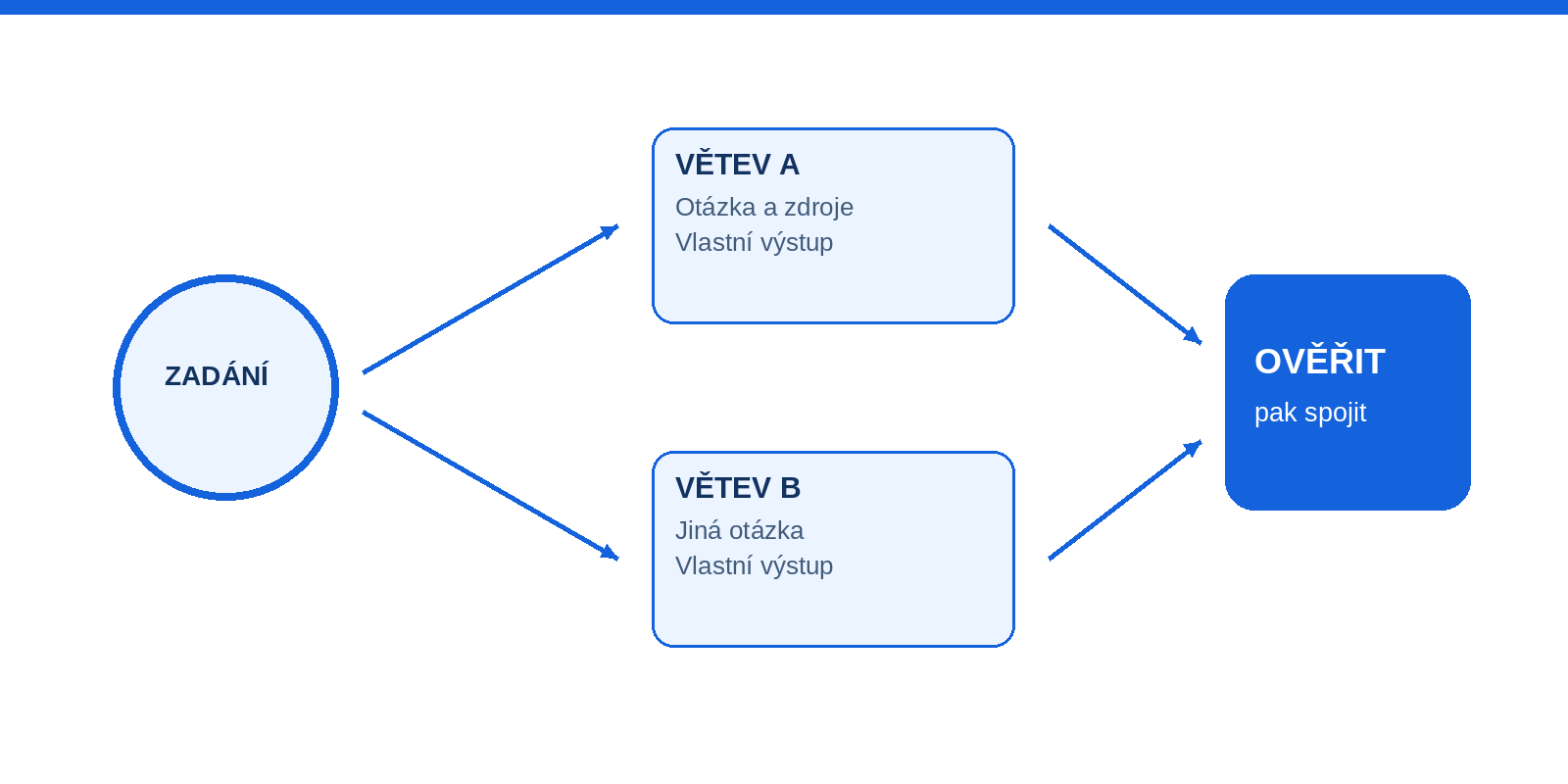

It makes sense to use a subagent when you can isolate a self-contained question and describe how you will recognise a correct result. Not simply when you want more agents. In Hermes, a child gets its own conversation and terminal session; what returns to the parent is primarily a summary. Responsibility for verifying sources and making the final decision does not pass to that summary.
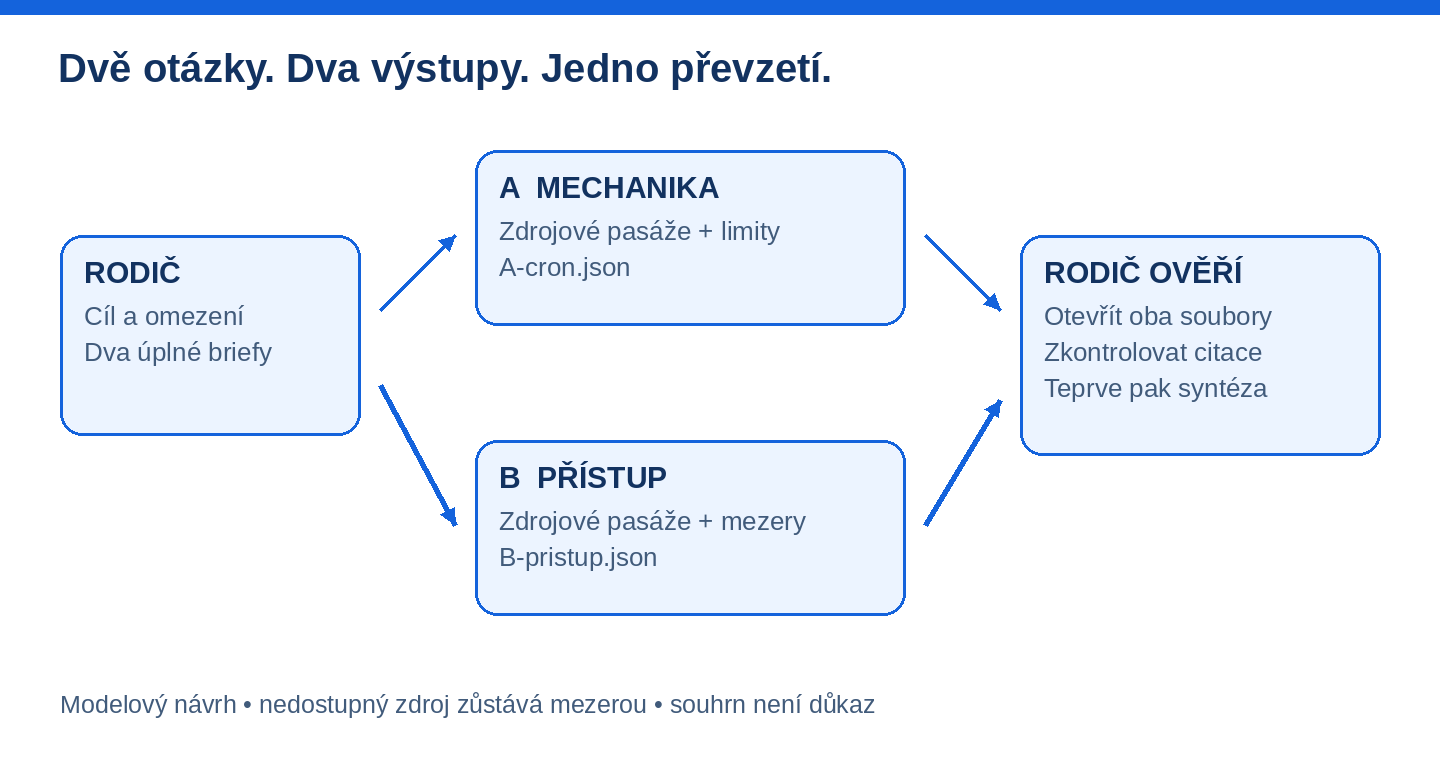
We will look at two independent research branches for a proposed report based on public documentation. Each receives a complete brief, its own output and a ban on operational changes. Finally, the parent checks them against the evidence, including a situation where one source could not be read. Neither child agent needs to know the other’s result to do its part.
Scope of this guide: a documented procedure and illustrative assignment based on sources checked on 19 November 2026. The reference stable release was v0.23.2 of 16 November. No delegation, inference or new profile was started here. The call below illustrates an agent tool, not a shell command; checking its structure does not prove a successful Hermes run. I explicitly discuss the discrepancy between the documentation and release notes on surviving a restart.



Split questions, not arbitrary pieces of work
Independent subtasks can start together. One researcher might establish when monitoring requires a model; another examines access rules for the resulting report. Both read public sources, but each answers a different question. Synthesis starts only after their results arrive, and the parent decides whether the evidence is sufficient.
“First download the data, then calculate a result from it” is a different situation. An analyst cannot process a dataset that does not yet exist. That is a dependent sequence, not a parallel branch. And if the job is merely downloading a few URLs, deduplicating them or recalculating columns, you usually do not need two more language models: use a direct tool or script. Delegation is useful for independent judgement or isolating a large intermediate step, not for the number of clicks.
A clean context can help reduce the inheritance of the parent’s assumptions, but does not itself create an independent human assessment. Two agents can make the same mistake from the same source. That is precisely why they need different questions, traceable evidence and shared acceptance rules, not just an instruction to “check it independently”.
Each child gets a self-contained brief and its own file
According to the reference, a child does not know the parent’s earlier conversation. Project context files from the workspace may be loaded, but that is no substitute for handing over the specific assignment. Include the goal, exact inputs, permitted files, output format, source locators and prohibited operations. “Use the file from last time” without a path and version remains incomplete even in a very long prompt.
The following two briefs form one illustrative batch. The directory /home/user/hermes-reserse/ is a fictional example that readers must replace with their own existing workspace and approve writing two new files. Access to real company data is not assumed anywhere. The sources are public; the date should be obtained with a tool during a real run, not copied from this article.
An illustrative delegate_task call: the Python notation shows fields passed to an agent tool. It is not a program intended to run in ordinary Python and does not create two new models without a running Hermes instance. It deliberately excludes installation, provider changes and account connections.
delegate_task(tasks=[
    {
        "goal": "Assess when a public-documentation monitor needs a model.",
        "context": """Illustrative project: design a daily report from public docs.
Question A: separate deterministic collection, text comparison and interpretation of changes.
The reader administers a small marketing team and is not a Hermes developer.
Input:
https://hermes-agent.nousresearch.com/docs/user-guide/features/cron
https://hermes-agent.nousresearch.com/docs/guides/automate-with-cron
Read the full relevant texts, including limitations, not just a search snippet.
Record the verification date, section heading, exact passage and URL for every claim.
Distinguish no_agent, pre-run script, wakeAgent and merely suppressing a message.
Mark inaccessible sources unavailable with a reason; never invent a passage.
The working root is /home/user/hermes-reserse/.
Only one new file may be created: /home/user/hermes-reserse/A-cron.json.
Do not overwrite an existing file; report finding it and ask the parent to decide.
JSON: otazka, overeno_at, tvrzeni[], mezery[], doporuceni, soubor.
Each claim: vyrok, url, sekce, pasaz, typ_dukazu, os_verze_limit.
Separate recommendations from documented facts and illustrative examples.
Write the output in Czech; retain source quotations in their original language.
Prohibited: installation, further delegation, cron jobs, model inference outside this turn,
logins, changes to configuration, credentials, session data, CMS and publication.
Do not run example commands; do not send messages or use paid tools.
Return the exact path, complete/partial/failed status and a list of unverified points.
Scope limit: these two primary sources, without expanding into other topics.
You do not wait for another branch or give final approval for operation.""",
    },
    {
        "goal": "Assess access to a report through Telegram without changing the integration.",
        "context": """Illustrative project: design a daily report from public docs.
Question B: what the administrator must check before giving a Telegram user access to the report.
The reader administers a small marketing team and is not a Hermes developer.
Input:
https://hermes-agent.nousresearch.com/docs/user-guide/messaging/telegram
https://hermes-agent.nousresearch.com/docs/user-guide/security
Read the full relevant texts, including limitations, not just a search snippet.
Record the verification date, section heading, exact passage and URL for every claim.
Distinguish the bot token, user ID, chat ID, allowlist and tool permissions.
Mark inaccessible sources unavailable with a reason; never invent a passage.
The working root is /home/user/hermes-reserse/.
Only one new file may be created: /home/user/hermes-reserse/B-pristup.json.
Do not overwrite an existing file; report finding it and ask the parent to decide.
JSON: otazka, overeno_at, tvrzeni[], mezery[], doporuceni, soubor.
Each claim: vyrok, url, sekce, pasaz, typ_dukazu, os_verze_limit.
Separate recommendations from documented facts and illustrative examples.
Write the output in Czech; retain source quotations in their original language.
Prohibited: installation, further delegation, creating a bot, tokens or a Telegram connection,
logins, changes to configuration, credentials, session data, CMS and publication.
Do not run example commands; do not send messages or use paid tools.
Return the exact path, complete/partial/failed status and a list of unverified points.
Scope limit: these two primary sources, without expanding into other topics.
You do not wait for another branch or give final approval for operation.""",
    },
])
Notice that the second brief does not refer to “the same restrictions as A”. The child receives everything it needs directly. At the same time, each may create a different file: an isolated conversation is not a separate filesystem sandbox. If both were told to write to one summary, having two terminals would not remove the risk of overwriting it. A prohibition in a prompt also does not replace access restrictions in tools and the system.
Check the actual child’s model and provider
A working parent does not prove that a different child model route works. The current reference lists global delegation.model and delegation.provider settings for default delegation. Without an override, children inherit the parent’s model; routing through another provider also requires that provider’s actual authentication. A successful login with one provider is not a credential for all the others.
The reference also describes delegation.base_url taking precedence over provider routing, and extension through strategies from the advanced-delegation plugin. The default call does not have a universal “model for this one subtask” parameter; the model_map and profile_routes strategies use preconfigured routes and have their own rules. Do not copy an arbitrary model parameter from another runtime into your installation.
For a batch, record the Hermes version, active strategy, actual provider and model chosen for each child, and any fallback. Do not record key values. If a route is rejected or authentication is missing, record the failure of that specific branch. Do not replace it with a paid provider without approval or present output from a different model under the original name.
Changing the model can change both quality and cost for the whole batch. A cheaper child may not be better value if the parent has to reread every source because the summary is wrong. For the first run, choose a small, well-specified task and track usage and the extent of corrections. No cost or savings were measured in this article.
Treat the summary as a claim, not a receipt
When the result returns, reading “done, everything verified” is not enough. The parent must open the exact declared file, compare the question with the brief and check the actual content. An existing JSON file proves that a document was stored, not that its quotations are true. For every decisive claim, open the relevant primary source and verify that the cited passage has the same meaning and scope.
If you use output_schema, it can help check the shape of the final response. The reference describes one bounded correction attempt and the possibility of schema_valid: false while preserving the child’s text. A valid schema does not verify a fact. URLs, paths, dates and quotations can be syntactically perfect and substantively wrong.
For these briefs, the parent should check the following in particular:
- Are both expected outputs, A and B, present, and did they stay within the permitted area? A missing file is not an empty successful result.
- Does every decisive claim include the exact URL, section, actual source passage and reading date? Has a snippet, example or recommendation been mistaken for evidence?
- Does A distinguish an unchanged state from incomplete input and a delivery error? Does B distinguish user identity from the destination chat and tool permissions?
- Do OS and version limitations match the current source? Has the child turned a cautious “may” into a guarantee?
- Do missing materials remain in the gap list, and are they reflected in the conclusion?
An illustrative synthesis when a source is unavailable
Suppose A delivers an evidenced distinction between script-only mode and interpretation, but B cannot read the security documentation. This is an illustrative scenario, not an account of an actual attempt. The parent’s correct conclusion would be: “The report mechanics can be designed using A’s verified sources. B’s access section is incomplete; these rules still need verification before connecting users.” Not “both agents confirmed safe operation”.
The parent can try another public primary-source route and state exactly what it actually read. If the source cannot be obtained, it omits the affected claim or passes a specific open question to a person. Other supported conclusions can be retained. There is no point rerunning the whole batch because of one unavailable page and hoping the next model will sound more certain.
External writes require an even stricter check: a child’s claim that it uploaded a file or sent a message must be verified by reading the exact destination. “Upload successful” from a child is not direct evidence. Such actions are prohibited in our brief, so if they occur, they are a scope violation, not a welcome bonus.
Limit concurrency and do not promise a universal lifespan
As of 19 November, the live reference listed a default concurrency of ten children and a further-delegation depth of one; the actual configuration can change these. Our example deliberately has only two branches and no further delegation. The default maximum is not a recommended load for your machine. A browser, container, long context and several model requests can consume more resources than the agent count alone suggests.
A complete budget covers the number of branches, source scope, permitted tools, model route and ability to stop. The reference describes delegation.max_iterations and idle checks; an iteration count is not an exact financial cap. A child stopped by its budget can return truncated: true and incomplete output. Do not call it complete research merely because it responded.
In interactive TTY chat, top-level delegation runs in the background: the parent can continue independent work, and the result returns between turns. For messaging, behaviour depends on delegation.gateway_mode. A finite CLI run, for example with -Q, chat --oneshot or non-interactive standard input and output, waits for children and receives their results in the same tool call. Do not start a synthesis that depends on both inputs before you have them. Stopping the current response and the /stop command are not automatically the same operation; use the available delegation controls for a specific child and then verify its state.
Different descriptions of lifespan remain side by side in the documentation. The section on durable delivery of a finished completion still says that it does not resume a running child after a crash and that a missing owner means an uncertain state. Newer sections of the same reference, “Continue a finished child” and “Resumable after a restart or crash”, describe a stored child record and continuation through action='continue' after a restart. Release v0.23.2 also explicitly announces durable subagents and continuation in their own conversation. It is therefore no longer accurate to say that all children always die with the process.
At the same time, continuation is not automatic retrying. According to the newer reference section, delegation.auto_resume is off by default; continuation must preserve the permitted model route and has restrictions based on state, session type and retained evidence. A manually stopped child is not the same case as one interrupted by a crash. The continue option is also not offered in one-shot and managed worker sessions. Storing a transcript does not restore its original running terminal processes or prove whether the last external write already happened.
After an interruption, first check the version, available continuation method, child state and actual artifacts. Only then decide whether to continue or start a new run; do not infer an exactly-once execution guarantee from the word durable. The new feature is documented, but its recovery was not runtime-tested here. Manage a long-term team with dependencies and separate review through an explicit persistent workflow, such as Kanban, rather than an endless tree of short delegations.
Sources and what this guide does not prove
The technical sources are Subagent Delegation, Delegation & Parallel Work and release v0.23.2, checked on 19 November 2026. The illustrative briefs list their intended primary inputs. This article does not demonstrate successful delegation, recovery after a crash or human assessment. The article on MCP and agents in marketing provides general context on permissions.
Let’s split the actual work and agree on verification
Are you considering multiple agents for research or a recurring analysis? Tell me which decision it should support. I can help distinguish independent questions, required evidence and responsibility for accepting the result. Sometimes that produces two useful branches. Sometimes it produces one well-specified task without further delegation.




